Duct connections
Appliances with round duct connections have connections with rubber seals.
Appliances with rectangular duct connections must be supplemented with a sealing strip.
The room-side ventilation must be connected to the appliance with flexible connectors. These must be installed in an extended length.
The ducts must be sealed with a gasket or other leak-proof element and insulation must be provided to minimize heat transfer in the ducts.
The size of the ducts must be determined on the basis of the air flow rate and the maximum external pressure drop of the appliance and must be designed according to the capacity of the appliance.
The fresh air intake and exhaust ducts connected to the outside environment must not be open.
Turbulent flows during intake and exhaust must be converted into a laminar flow by installing a straight duct section or an expansion piece to reduce the pressure drop, otherwise an unexpectedly large pressure drop would occur.
Wrong | Right |
|---|---|
|
|
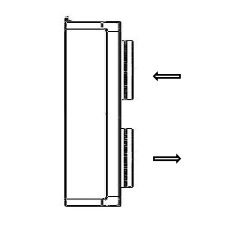
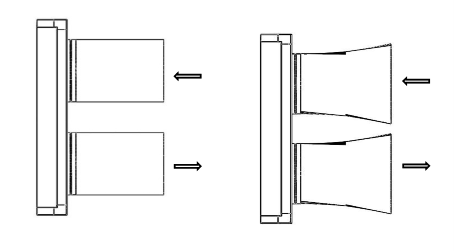
Changes to the duct sections at the air inlet and outlet of the appliance must be made using a reducer. Ducts with different cross-sections must not be connected directly to the inlet and outlet sections of the appliance. Changes in cross-section must be made with a minimum angle of 15 degrees.
Wrong | Right |
|---|---|
|
|
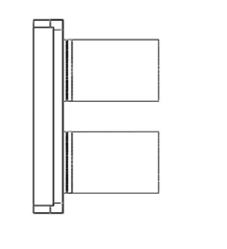
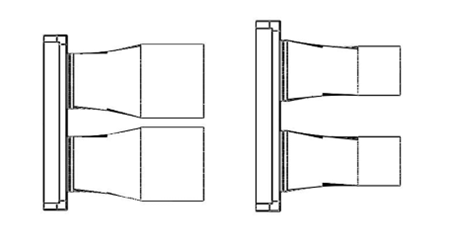
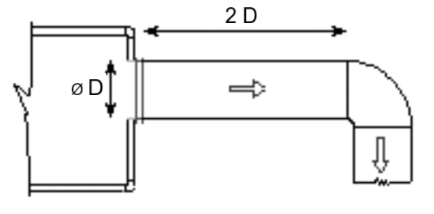
In cases where the direction of the airflow is to be changed immediately after the discharge or intake section of the unit, or in cases where a device (ducted electric heater or ducted water heater) is to be installed upstream of the standard bends or upstream of the unit as shown in the figure below, twice the equivalent diameter must be provided.
By installing a parallel duct at a certain distance, the pressure drop caused by the change in air flow direction is minimized.
Suitable transition pieces must be used for the transition from round to rectangular or from rectangular to round. It should not be connected directly to a rectangular section or a rectangular section to a round section.
A wire mesh should be used at the fresh air inlet and at the outlet to the outside to prevent the ingress of rainwater and foreign bodies.